Gross unemployment insurance
Public insurance paid over the model year, including eligible support after lower-paid re-employment.
Supporting analysis / Fixed 2024 rules
Compare gross unemployment insurance and covered employment receipts for the same assumed transition. This twelve-month standard-worker exercise supports the German ten-year study.
Comparative policy module
Choose the household income reduction separately from the worker transition.
The one-worker view follows one affected, eligible worker. The group view repeats this profile 1,000 times and applies the selected affected share. Group changes equal affected workers × the per-affected-worker change.
Immediate job-to-job move: zero unemployment months means no unemployment-insurance claim opens. Change time without work to explore a gap before the next job.
Gross unemployment insurance
Public insurance paid over the model year, including eligible support after lower-paid re-employment.
Change in covered fiscal balance
Employment-receipts change minus gross-insurance change. A negative value is an additional covered cost.
Employment-related receipts
Income tax and employee/employer public social contributions.
After-benefit-tax worker income
Unestimated during unemployment: benefit taxes, other charges and final annual assessment are missing.
A partial fiscal account. Benefit taxation, other out-of-work charges and several support programmes are excluded. Worker cash is not complete disposable income. Accounting boundary ↗
Missing or incompatible benefits are left unestimated.
Worker perspective
Public-budget perspective
Changes against continued employment at starting pay. Benefit-tax offsets and wider fiscal effects are outside this account.
03 / POLICY COMPARISON
The same transition assumptions in each system, scaled by local gross benchmark earnings. These are conditional policy calculations, not a ranking of welfare-system adequacy.
Share of annual gross benchmark earnings
Supporting analysis · methods and scope
The comparison model note explains the standard worker, fixed 2024 rules and partial fiscal account. The working paper studies Germany over ten years; these results are separate supporting analysis.
The main SPAR study asks how additional job separations and the duration of unemployment affect Germany’s public budget over ten years. This complementary module compares gross insurance protection and covered employment-related receipts for the same assumed transition across seven policy systems.
Comparison model note · German working paper · Checked insurance rules and provenance
A single adult living alone without children, age 40, with 21 continuous years of insured full-time employment. Starting earnings are 100% of each country’s 2024 OECD average wage. Assume involuntary dismissal, timely registration and active search, no sanctions, severance deferrals or other income, and full take-up of the insurance programmes modelled.
Denmark assumes long-standing full-time A-kasse membership. Japan assumes all prior benchmark earnings were regular monthly pay, without excluded bonuses. Country-specific eligibility is conditional: this profile is not an average unemployed person.
The 1,000-worker view repeats the same profile; it is not a representative sample or a national forecast. One-worker view follows one affected worker when the affected share is positive; at 0% it follows baseline.
Baseline: 12 months in the original full-time job at starting pay. In the scenario, affected workers leave at the start and return once after the selected jobless spell, at the selected gross pay. Unaffected workers retain baseline. A direct job-to-job move does not open an insurance claim in this illustration.
AI displacement, re-employment time and next-job pay are user assumptions, not forecasts. This is a fixed-policy comparison, with no GDP growth, inflation, prices, demand feedback or representative national scaling.
Gross insurance is reconstructed from archived OECD 2024 country policy descriptions, checked against primary national rules where needed. Germany also has an independent 2024 BA calculator fixture. These are calculated entitlements, not retrieved TaxBEN case exports or observed average receipts.
The model includes declining benefit stages, waiting periods and expiry. Dutch WW and French ARE can continue after lower-paid full-time re-employment, under the stated registration and eligibility assumptions. Denmark’s two employer G-days are included in worker cash separately from government insurance; the enhanced 481-hour clock and one-day deduction per four months (karens) are tracked.
No net replacement rate is treated as government spending. No unestimated benefit tax or other charge is asserted to be zero.
After-benefit-tax worker income: left unestimated in unemployment cases. The chart separately displays wage take-home and gross insurance; adding those amounts cannot establish a disposable-income gain.
Tax receipts: employment PIT and employee/employer public social contributions only. Support: gross public unemployment insurance, including implemented continuation with lower-paid work. Employer G-days are excluded from this card.
Covered public balance change: employment-receipts change minus gross-public-insurance change. Negative is a cost in these channels. Benefit-tax offsets, other support and wider fiscal effects are excluded, so this is not the total budget effect.
Wage-tax anchors come from Taxing Wages 2025, policy 2024: single childless employees at 67%,100%,167% of average wage. Components are interpolated separately between anchors, never beyond them. This misses thresholds within intervals. Published rounding can leave a one-unit income residual.
Annual employed cases are prorated across months. Insurance parameters are frozen at January 2024. France and Japan use illustrative 30-day months; Belgium 26 paid days; Michigan 52/12 weeks, capped at 20. Denmark uses 160.33 hours. These are transparent allocation conventions, not agency payment calendars or exact annual tax assessments. French daily-cent rounding remains approximate. OECD's French employment-tax anchors also omit 1.8% parameter indexation; they are retained as published source cases, not exact effective liabilities.
Means-tested assistance, housing and healthcare subsidies, Japan’s re-employment grant, and other programmes are not calculated. Insurance ending means only that this insurance entitlement has ended, not that all help disappears.
Taxes and deductions on benefits, lagged Japanese resident taxes and health/pension charges, private compulsory payments, and final annual tax adjustments are outside this account. Benefit amounts are gross; the model does not quote an individual’s spendable income or entitlement.
| Country | Annual gross benchmark | Employment cases | Insurance coverage |
|---|
Comparison percentages divide changes by the country’s annual gross benchmark wage, multiplied by the selected group size. They are not percentages of GDP, government spending or prior take-home income. Local amounts are shown alongside percentages; currencies are not converted or ranked as equivalent.
Employer contributions enter public receipts but are not deducted from gross worker pay a second time. Government-to-government insurance funding is not counted again as household cash support. VAT, corporate taxes, public services, future pensions and macro feedback remain outside these cards.
Open the integrated Germany dashboard ↗
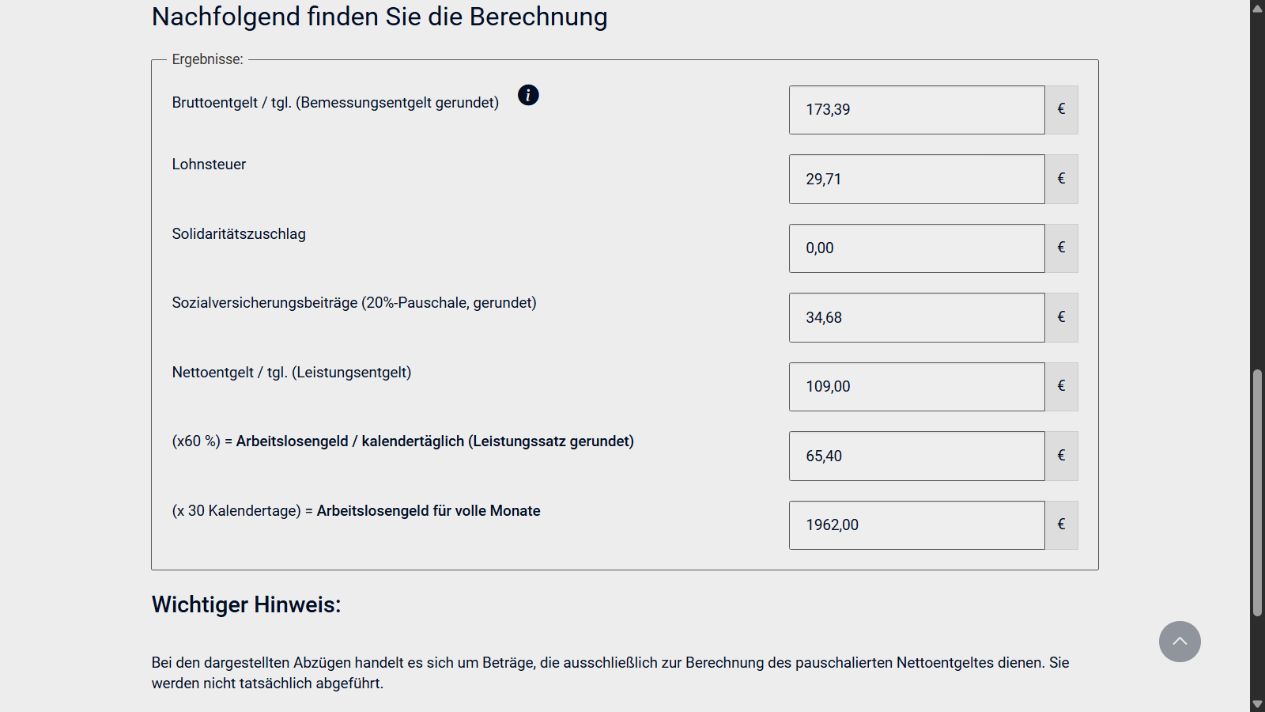
The integrated Germany dashboard follows the same synthetic workers over ten years, with fixed 2025 tax-benefit rules, ordinary transitions, earnings recovery and an optional corporate-profit experiment. Sourced national benchmarks provide context; the synthetic results are not expanded into national totals. This complementary module uses a one-year standard-worker comparison with 2024 benchmarks and a narrower fiscal account. The results are not interchangeable.
Corporate profit remains assumption-dependent and separate. Layoffs alone do not identify a taxable profit gain.