Preliminary midterm results · 17 October 2026
The fiscal balance depends on both re-employment and assumed domestic profit taxation. These are conditional model calculations; they do not estimate the probability of an automation path or the effects of a new tax on adoption.
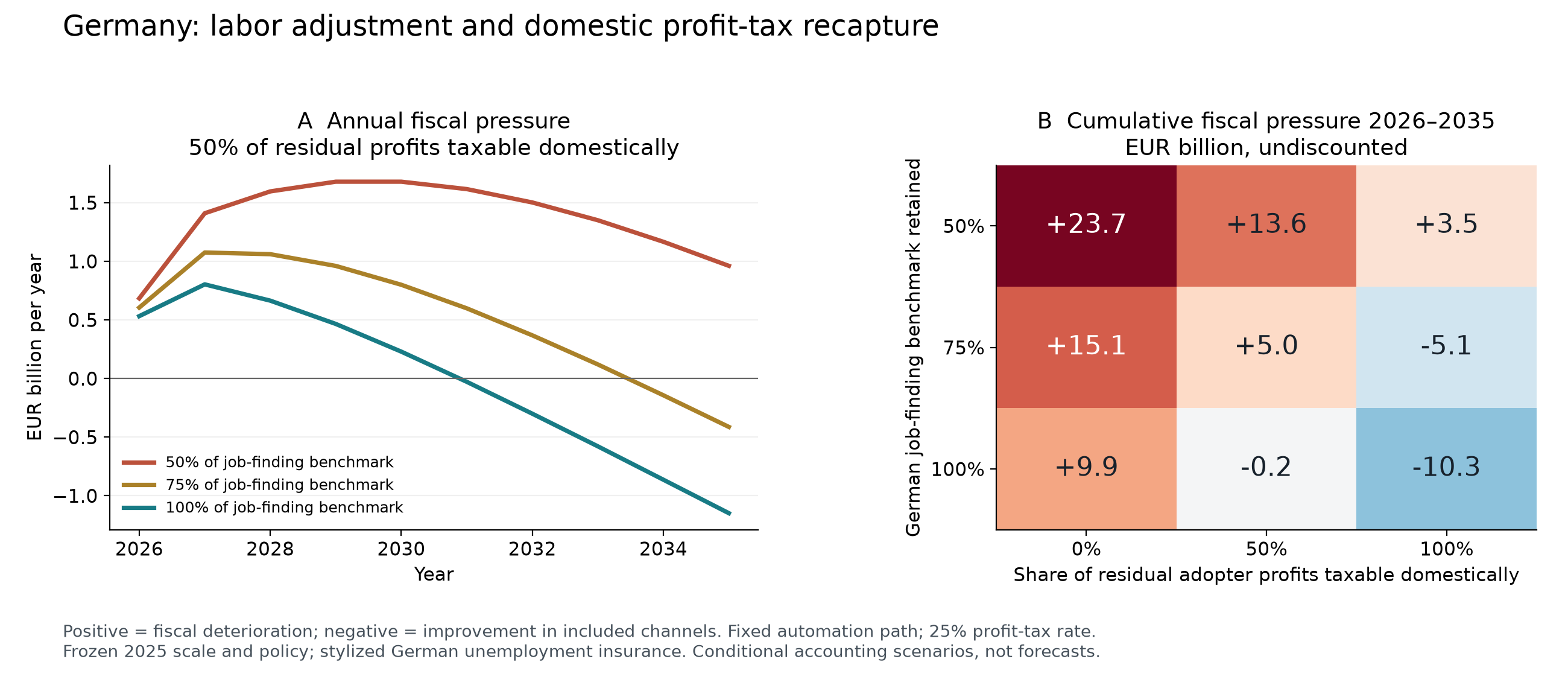
We run nine Germany scenarios over 2026–2035, holding the dashboard's working central automation assumptions fixed: additional automation rises linearly from zero to 20%; the Belgian-reference susceptible share is 27%, reweighted using German occupational composition and ILO scores; 25% of automated susceptible work converts into displacement. Re-employment entails a 10% gross pay loss, subject to the existing German wage floor. Inactivity and repeated displacement are excluded.
Historical German quarterly job-finding benchmarks of 34% for unemployment under one year and 12% for longer durations are multiplied by 50%, 75% or 100%. Thus quarterly probabilities are 17/6%, 25.5/9% and 34/12%. Monthly probabilities use 1 − (1 − quarterly probability)^(1/3), an absorbing constant-hazard approximation. These are sensitivity assumptions, not estimates of AI-specific re-employment.
Employer savings fund AI costs (10%), price reductions (20%), survivor employer-cost raises (15%) and residual adopter profit (55%). The domestic taxable share of that residual profit is 0%, 50% or 100%, taxed at an assumed fixed effective rate of 25%; the corresponding effective recapture is 0%, 12.5% or 25% of residual profit. The 25% rate is a scenario parameter, not a claim about the German statutory corporate tax burden. AI-supplier tax footprints are not added.
German representative-worker employment tax functions are retained. The Belgian benefit function is replaced only for these runs by a stylized German insured, childless, under-50 cohort: 60% of modeled net pay, calculated on gross wages capped at the existing 2025 EUR 96,600 ceiling, for twelve months. This approximates rather than reproduces the statutory standardized net-pay calculation. All displaced profiles are assumed eligible with sufficient insurance history; post-entitlement assistance, household means tests, progression effects and detailed benefit-related social-insurance flows are omitted.
Annual pressure equals lost employment receipts plus modeled cash benefits minus residual-profit tax. Survivor raises can offset employment-receipt losses. VAT and new AI levies are disabled. Monetary outputs scale the 10,000-profile cohort to EUR 1,737.436 billion of 2025 non-government German gross payroll. Percentages use fixed 2025 general-government spending of EUR 2,259.341 billion. Cumulative euro values sum ten annual flows without discounting; they are not annual budget percentages. No inflation or wage growth is imposed.
Positive values indicate fiscal pressure; negative values indicate improvement in included channels. Worker counts remain per original 10,000 profiles, rather than nationally extrapolated headcounts.
| Job-finding benchmark retained | Domestic taxable profit share | 2035 EUR bn | 2035 % of spending | 2026–35 EUR bn | 2035 unemployed / 10,000 |
|---|---|---|---|---|---|
| 50% | 0% | +2.89 | +0.128% | +23.75 | 33.1 |
| 50% | 50% | +0.96 | +0.043% | +13.65 | 33.1 |
| 50% | 100% | -0.97 | -0.043% | +3.55 | 33.1 |
| 75% | 0% | +1.51 | +0.067% | +15.14 | 19.1 |
| 75% | 50% | -0.41 | -0.018% | +5.03 | 19.1 |
| 75% | 100% | -2.34 | -0.104% | -5.07 | 19.1 |
| 100% | 0% | +0.78 | +0.034% | +9.88 | 12.1 |
| 100% | 50% | -1.15 | -0.051% | -0.22 | 12.1 |
| 100% | 100% | -3.08 | -0.136% | -10.32 | 12.1 |
Across nine conditional Germany scenarios, annual fiscal pressure in 2035 ranges from a EUR 3.08 billion improvement to a EUR 2.89 billion deterioration. Cumulative pressure over 2026–2035 ranges from −EUR 10.32 billion to +EUR 23.75 billion. With half of residual adopter profits taxable domestically at a 25% rate, halving historical job-finding probabilities raises cumulative pressure from approximately −EUR 0.22 billion to +EUR 13.65 billion. At unchanged job-finding probabilities, eliminating the profit-tax offset raises cumulative pressure from −EUR 0.22 billion to +EUR 9.88 billion.
The common automation path removes approximately 134 original positions per 10,000 profiles cumulatively by 2035 (1.34%). End-year unemployment ranges from 12 to 33 profiles per 10,000, depending on re-employment assumptions. At 50% job-finding retention and full domestic profit capture, the 2035 balance improves by EUR 0.97 billion while cumulative pressure remains positive at EUR 3.55 billion: a favorable endpoint can conceal earlier fiscal costs.
These calculations illustrate how labor adjustment and domestic recapture jointly shape fiscal pressure. Recapture changes the fiscal balance mechanically and does not change employment in this model; faster re-employment restores employment receipts and reduces benefits. Antoine's static model studies input choice and tax incentives. This dashboard adds a conditional transition analysis, without claiming to implement his equilibrium or identify an optimal AI tax.
The results are conditional on modest displacement and assumed redistribution of employer savings, including survivor raises. Negative pressure is not an estimate of welfare or GDP gains. Frozen 2025 tax rules and macro denominators, 2022 occupational earnings, broad occupation proxies and simplified benefits constrain national interpretation. Longer-duration support is omitted, so these are partial fiscal accounts rather than estimates of total unemployment costs. The nine scenarios are a sensitivity grid, not a confidence interval. Next priorities are validation of German benefit and tax calculations, re-employment earnings losses and domestically taxable profit shares.
The retained dashboard calibration bundle records Eurostat datasets, filters and source vintages (retrieved 9 October 2026). German benefit design is informed by the Federal Employment Agency's eligibility, amount and duration guidance (consulted 17 October 2026). The 60% replacement and twelve-month maximum require the specified cohort assumptions; modeled net pay is a research approximation.
Run germany-midterm.cjs from the eu-labour-scenarios project directory. The runner loads the existing engine with a local benefit override and leaves the dashboard engine unchanged. Original validation passed 16,304 checks; the scenario runner additionally checks benefit expiry and cap behavior, fiscal identities, recapture ordering and unemployment ordering.
Annual results CSV · Summary CSV · Parameters and results · Vector figure